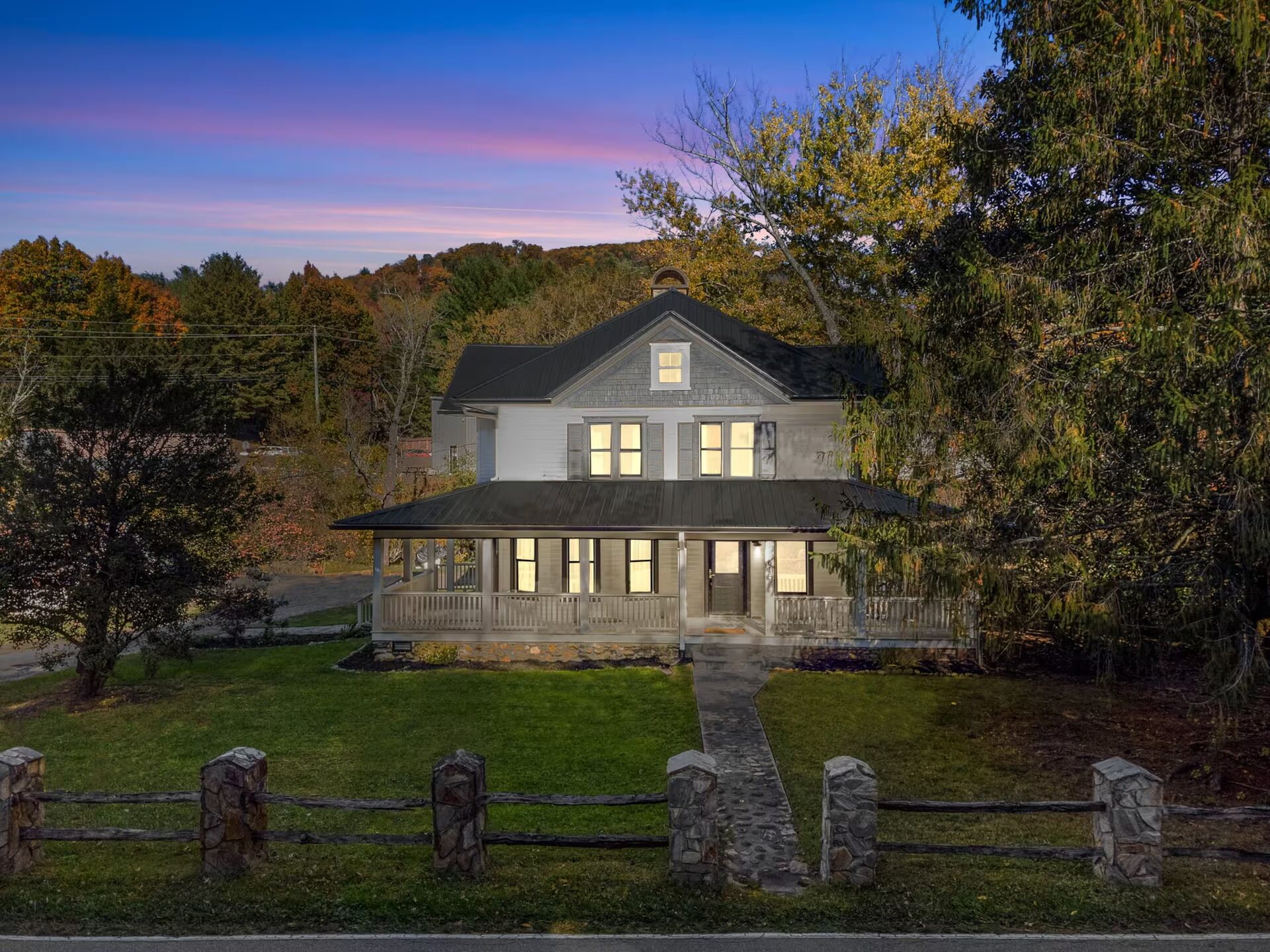
There are two ways to remodel an old house. You can gut it and start over, which is faster and usually cheaper, or you can do the harder thing, which is figure out what made it worth saving in the first place and build everything else around that.
In Asheville, Black Mountain, Weaverville, and Hendersonville, older homes are part of what makes the area worth living in. The craftsman bungalows, the farmhouses, the century-old colonials sitting on quiet streets, these are not just houses. They have a presence that newer construction rarely achieves. The challenge for homeowners and contractors alike is updating them for the way people actually live today without erasing the thing that made them interesting.
That tension is exactly what we navigated on Rose Hill Road.
When the House Has a History
The Rose Hill Road project was a home built over 120 years ago and last updated sometime in the 1960s. Walking through it the first time, the condition was livable but frozen in time. The kind of house where you can feel the decades in the trim details, the original windows, the way the rooms connect to each other.
The overall size and layout presented the first real challenge. Homes built at the turn of the century were designed around a completely different way of living. Bedrooms had small closets because people owned less. Bathrooms were functional, not retreats. And the kitchen on this particular house had three separate entrances, a design decision that made perfect sense when household staff, family, and deliveries all needed their own access. It makes considerably less sense for a modern family trying to figure out where to put the island.
Understanding why a house was built the way it was helps you make better decisions about what to change.
The Layout Problem Nobody Warns You About
Older homes in Asheville and the surrounding area were not designed around the floor plan expectations of today's buyers. No large primary suite. No walk-in closets. No open connection between the kitchen and living areas that everyone now considers standard.
Changing a layout in a 120-year-old home is not the same as changing a layout in a 1990s colonial. The framing reflects decades of modifications. Walls that look non-structural sometimes aren't. Plumbing runs in places that made sense in 1905 and nowhere else. Every layout change becomes a conversation with the house about what it's willing to give up.
On Rose Hill Road, we worked through those conversations room by room. The goal was a modern layout that didn't announce itself, changes that felt inevitable rather than imposed.
What to Keep and What to Let Go
The rule we kept coming back to was simple. Keep anything with character. Update everything that was purely functional.
Original trim, doors, hardware, flooring, the things that carry the visual identity of the home, those stayed wherever we could make them work. The three-entrance kitchen became a design problem to solve rather than a feature to preserve, but the decision about what to do with it came from understanding the house first, not from a floor plan template.
This is where older home renovations in Asheville go wrong most often. Contractors and homeowners alike get impatient with the constraints and start making decisions based on what's easiest rather than what fits. The result is a house that looks remodeled, which is not a compliment. The goal is a house that looks like it was always this way.
The Bathroom Question: Cast Iron, Low Ceilings, and Modern Expectations
The primary bathroom on Rose Hill Road is where the tension between old and new was most obvious.
The ceilings came in at seven and a half feet, which sounds fine until you're standing in a bathroom trying to make a space feel generous and well-proportioned. Seven and a half feet in a small room feels compressed. Raising them was not optional, and raising ceilings in an older home is not a small task. You're working around framing, insulation, and whatever the floor above has going on. It takes planning and it adds cost, but the difference in how the finished room feels is not subtle.
The cast iron tub was a harder conversation. Cast iron tubs from that era are genuinely beautiful and built better than almost anything manufactured today. We wanted to keep it. In the end, the decision came down to what the primary bathroom needed to be for the people living in it. The tub came out and a walk-in shower went in. The space became something people actually use every day rather than a feature they appreciate from the doorway.
That's the right trade-off, but it's worth knowing it's a trade-off.
Fitting the Neighborhood Without Disappearing Into It
One of the things that gets overlooked in older home renovations is the relationship between the house and its street. Homes in established Asheville neighborhoods have a visual language. Certain proportions, certain materials, a certain relationship to the lot and the neighbors. A renovation that ignores that language can produce a house that feels out of place even if every individual decision was reasonable.
On Rose Hill Road, the exterior work stayed consistent with what the house had always communicated to the street. The updates were about the people living inside, not about making the house look like something it wasn't.
Your own personal touch belongs inside. That's where you live.
When It's Done Right, You Forget What It Used to Look Like
The best thing anyone said about the Rose Hill Road project was also the simplest. When it was finished, it was hard to remember what it used to look like. Not because the old house was gone, but because the new version felt so inevitable that the before seemed impossible to picture.
That's what a successful older home renovation feels like. Not a transformation. More like a correction.
If you're looking at an older home in Asheville, Weaverville, Black Mountain, Candler, or Hendersonville and trying to figure out whether it can become what you want it to be, that's exactly the kind of project we do well. You can see more of the Rose Hill Road work in our project portfolio or reach out directly at woodedmountainbuilders.com/contact or call (828) 618-4837.